
14 Types of Value in Asset Valuation, Explained
By Harihar S, Chartered Engineer & IBBI Registered Valuer
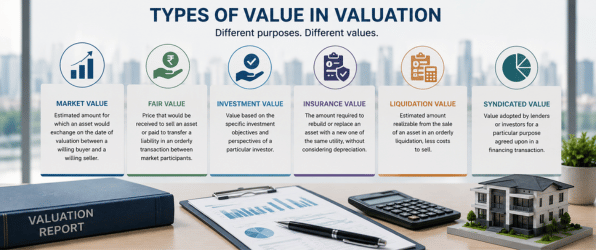
What “Type of Value” Means in a Valuation Report
Valuation involves determining the worth of an asset, and different types of value are considered based on the purpose and context of the valuation. The type of value used changes the answer, the same property has a different figure depending on whether the report is for a sale, a bank loan, or an insolvency proceeding.
The 14 Types of Value, Compared
| Type of value | Definition | Typically used for |
|---|---|---|
| Market value (FMV) | Price in an open, competitive market between a willing buyer and seller | Sales, general transactions |
| Fair value | Defined accounting value under Ind AS 113 / IFRS 13 | Financial reporting, impairment testing |
| Investment value | Value to a specific owner or investor, not the open market | Investment decision-making |
| Intrinsic value | Value based on underlying fundamentals of the asset itself | Long-term asset assessment |
| Book value (NAV) | Historical cost less accumulated depreciation | Accounting records |
| Liquidation value | Value in a forced or time-constrained sale, required alongside fair value in NCLT/IBC valuations | Insolvency, distress sales |
| Going concern value | Value assuming continued operation | M&A, business continuity assessments |
| Salvage value | Residual value at the end of useful life | Depreciation schedules, disposal |
| Replacement cost value | Cost to replace with an equivalent new asset, see plant and machinery valuation | Insurance, cost-approach valuations |
| Economic value (EVA) | Value added above the cost of capital | Performance and investment analysis |
| Synergistic value | Incremental value from combining with another asset or entity | Strategic acquisitions |
| Special value | Value to a particular buyer beyond market value | Niche or strategic transactions |
| Guideline value / circle rate | Government-notified minimum value for stamp duty, see real estate and infrastructure valuation | Property registration, stamp duty |
| Market rent | Estimated arm's-length lease rent on the valuation date | Leasehold valuations |
Where Fixed Assets Sit in the Ind AS 113 Fair Value Hierarchy
Ind AS 113 / IFRS 13 rank fair value inputs in three levels: Level 1 (quoted prices for identical assets in active markets), Level 2 (observable inputs for similar assets), and Level 3 (unobservable inputs requiring valuer judgment). Land, buildings and plant & machinery are typically Level 2 or Level 3, since identical assets rarely trade in an active market, which is exactly why an IBBI Registered Valuer's documented judgment is required for the fair value used in financial reporting and compliance.
Frequently asked questions
What is the difference between market value and fair value?
Market value is the open-market price between a willing buyer and seller. Fair value is a defined accounting term under Ind AS 113 / IFRS 13, used specifically for financial reporting.
Which type of value applies to bank lending or NCLT proceedings?
Fair market value for standard lending, and both fair value and liquidation value reported separately for NCLT/IBC insolvency proceedings.
Partner with Axium for expert valuation services
Have questions first? Call +91-8939-891329
Not ready yet? Browse our Resources for guides on IBBI registration and fee schedules.